

I’ll be honest—my week didn’t start out thinking I’d be hotly debating backend tech, let alone investigating mysterious Twitter API quirks and Livewire 4’s rise. But then two things happened: first, an unassuming tweet from the Vercel CEO set off a storm about which language really “runs the world.” Second, a flurry of Livewire 4 news had my group chat burning up with opinions, memes, and half-baked migration plans. If you’ve ever been caught between hype and hard numbers, or just love the way developer communities pulse with energy (and a little chaos), you’ll get where I’m coming from. Buckle up—this isn’t your mom’s changelog recap.
Livewire 4 Unleashed: More Than A Simple Upgrade
When I first opened up a Livewire 4 project, I felt a mix of excitement and confusion—like stumbling across a hoverboard in a garage full of rollerblades. But after diving in, it’s clear: Livewire 4 is not just an upgrade; it’s a whole new way of building Laravel apps. Let’s break down what makes Livewire 4 features so influential for the Laravel ecosystem.
Single-File Components: The Heart of the View-First System
Livewire 4 introduces single-file components, a game-changer for anyone who loves clean, organized code. With the new .wire.php file format, you can combine your PHP logic, Blade markup, and even JavaScript into one file. This view-first approach means your components are easier to manage and reason about. I found myself moving faster, with less context-switching and fewer files to juggle.
Performance Improvements: Blaze Compiler Brings the Heat
Performance is where Livewire 4 truly shines. The new Blaze compiler is at the core of these improvements, reportedly making Blade rendering up to 10x faster. This isn’t just a small bump—it’s a leap. Whether you’re building dashboards or dynamic forms, the speed boost is instantly noticeable. As Caleb Porzio highlighted at Laracon US 2025, these changes are all about making the developer experience smoother and more productive.
Blade-Style Slots & Enhanced Component Flexibility
Another standout in Livewire 4 features is support for Blade-style slots and flexible component attributes. This means you can create more reusable, dynamic components with cleaner syntax. Enhanced loading states and smarter data-loading attributes also make your UI feel more fluid and responsive. For me, this flexibility is a huge win—components now feel as powerful as those in React or Vue, but with the simplicity of Blade.
Migration: Not Required, But Worth It
If you’re coming from Livewire 3, migration isn’t mandatory. But embracing the new .wire.php structure and performance improvements unleashes the real power of Livewire 4. The upgrade path is smooth, and the payoff in speed and developer happiness is immediate.
"Livewire 4 is one of my favorite front-end frameworks alongside React."
Livewire 4 isn’t just keeping up with the JavaScript ecosystem—it’s setting a new standard for Laravel development.
Backend Battles & The Vercel CEO’s Hot Take
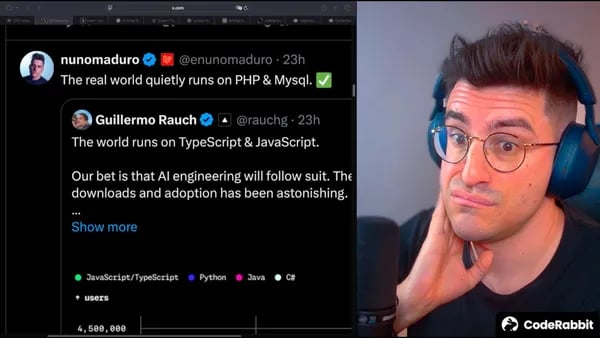
Let’s talk about the moment that set PHP and Laravel developers buzzing: the Vercel CEO’s claim that “the world runs on TypeScript and JavaScript.” This statement, delivered during a keynote and backed by a flashy graph, was meant to highlight the meteoric rise of JavaScript (and TypeScript) in backend development. But for those of us deep in the trenches of Laravel development 2025, Livewire 4, and the broader PHP ecosystem, it felt like a direct challenge—one that didn’t quite match the real numbers.
What the Vercel CEO Actually Claimed
The CEO’s words were clear: JavaScript and TypeScript are “running the world.” The supporting graph showed downloads and GitHub activity, painting a picture of total JavaScript dominance. But here’s where the backend battles heat up. Many of these stats rely heavily on GitHub metrics—numbers that can be inflated by bot pull requests, automated dependency updates, and the sheer volume of JavaScript packages. It’s easy to get the illusion that JavaScript is everywhere, but is that the whole story?
Why PHP Developers Were Fuming
As someone who lives and breathes PHP, my first reaction was disbelief. I know, and the data backs it up: over 70% of the web still runs on PHP. That’s not just WordPress, but also platforms like Drupal, Magento, and modern frameworks like Laravel and Livewire 4. When people dismiss these as “just WordPress,” I have to ask—if you count React or Vue.js for JavaScript, why not count WordPress for PHP? It’s all part of the real backend landscape.
The Real Pulse: PHP vs JavaScript Backend
The backend wars are about more than code—they’re about developer identity. The Vercel CEO’s claim sparked a wave of replies and memes, but the facts remain: “The real world runs quietly on PHP and MySQL, which is something I truly believe on still.” Laravel, Livewire, and the vast PHP ecosystem power the majority of websites, even if JavaScript gets the hype.
GitHub stats can be misleading—bots and automated updates inflate JavaScript numbers.
PHP powers 70%+ of the web, including giants like WordPress.
Backend battles are as much about culture as technology.
Sometimes, the best reply is hard data. Other times, a well-timed meme says it all.
Easter Eggs: Twitter APIs & Laravel’s AI Future
You know you’re deep in the trenches of web development when a stray 404 status code sparks a revelation about how the internet really works. This week, while poking around Twitter’s internal APIs, I stumbled on something that felt like an easter egg for backend nerds: some telemetry and analytics endpoints were returning 404 errors. At first, I chalked it up to a bug—after all, if the frontend is reaching out and the backend just shrugs with a “not found,” that usually means something’s broken. But the more I dug, the more interesting it got.
Curious, I asked an AI assistant for its take. The response?
"The AI said that 404 also prevents caching like cache control...which helps hide the endpoint from bots, which is insanely interesting."
That’s a subtle but powerful trick: by returning a 404 instead of a 204 (which simply acknowledges the request with no content), Twitter’s backend can keep bots and aggressive scrapers at bay, while also avoiding unnecessary caching. It’s a tiny detail, but it reveals how even the smallest API choices ripple out into real-world security and performance. When I tweeted about this, it hit a nerve—1,600 likes later, it was clear that the developer community is hungry for these behind-the-scenes insights.
Why does this matter for Laravel developers? Because the same kind of quiet innovation is happening in our ecosystem. Taylor Otwell’s announcement of the Laravel AI SDK is a perfect example. As we head toward Laravel development in 2025, AI-enhanced workflows are moving from the edges to the core of our toolkits. The Laravel AI SDK isn’t just a shiny add-on; it signals a future where backend frameworks like Laravel will seamlessly bake in AI and smarter data layers—sometimes without us even noticing. The migration to Livewire 4 and the evolution of Laravel development tools are all part of this bigger shift.
My bet? The next wave of backend frameworks will quietly integrate AI, just like Twitter’s hidden 404s—subtle, powerful, and mostly invisible until you know where to look. That’s the real pulse of Laravel development: constant evolution, hidden in plain sight, and always a step ahead.
